Categories
poetry

‘Swaying, Swaying In The Breeze’

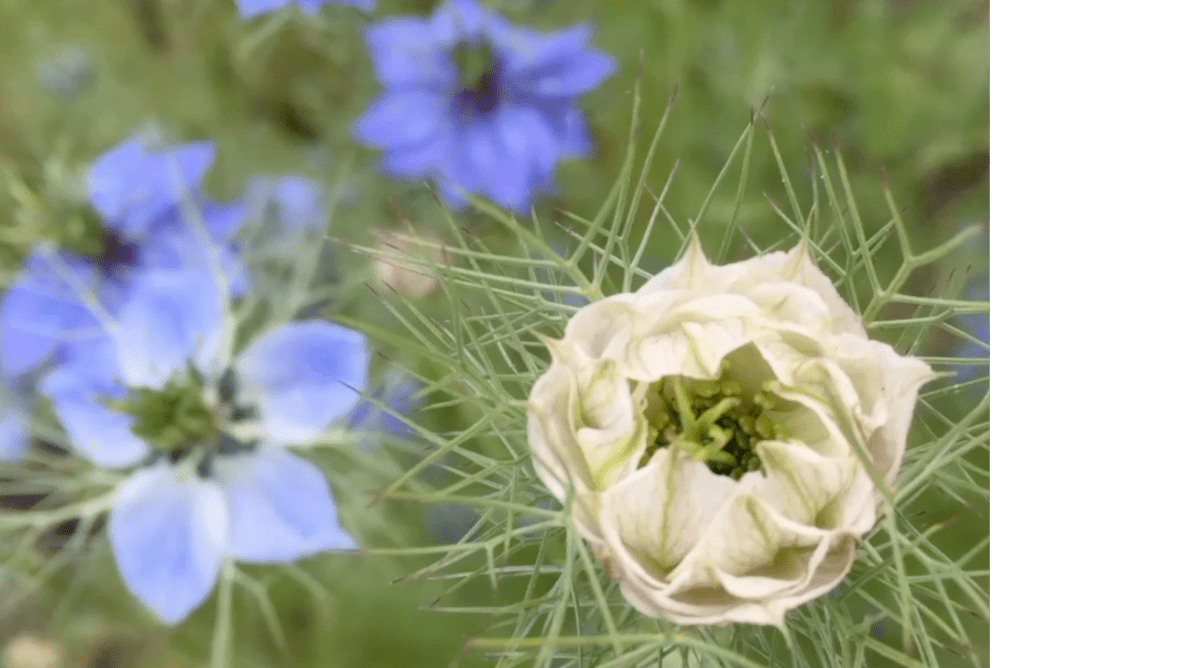
It was around the time of the Chelsea Flower Show one year and I was walking along the path in my front garden. Although it was windy, the blue sky just held its own on that sunny afternoon in May. My eyes noticed something moving in the breeze – it was the flowers. It was, as if, I saw the flowers in that light for the first time – dancing.

How many decades had I lived here…? How many flowers had I seen grow, flourish and change with the seasons in my garden…? And how many days, weeks and months of beautiful summer weather had I witnessed…? Not forgetting the aggregate of creatures over a couple of decades, or so, that may have happened upon them…?

There was a bee or two doing what they do best in such natural environments, just buzzing about from flower to flower. These were no ordinary bees – they were my bees!

I was compelled; out came my phone. For the next however-long, I filmed them: the bees… the flowers… and the breeze…

Early the next morning when my eyes had barely opened, I was thinking about this scene. My mind was fixated; I could not stop thinking about it all; I was obsessed; over and over and over: the bees… the flowers… and the breeze… Compulsion grabbed me again and I stole my pen. For a good, long while I toiled: trying this here, something else there, moving the other somewhere else… And then, two hours later, I struck gold – I wrote the last word. Phew! It wasn’t until I returned the pen that I could once more live a normal life. I was satisfied. I was quenched. I was full. And I was free from my malady – safe. The only thing I needed to do was have breakfast – and so I did. And continue with my day.

Swaying, Swaying In The Breeze

Swaying, swaying in the breeze

Dancing, dancing beneath tall tree

Moving another way in slight air

So handsome, so pretty, so fair

Hues and shades, rare and fine

What invention, what design…”

– first verse

Just for a moment or two, let your imagination go and think of long ladies with long, wavy hair, wearing long dresses, during long, hazy summer days dancing in circles beneath… a tall tree…

Here is a video recording of myself performing the first verse: Swaying, Swaying In The Breeze

Categories
poetry

‘Gone Fishing’

“The assignment, if you choose to accept, is to write a poem about fishing.” Well, that wasn’t quite the directive from Her Majesty’s Secret Service but by a local poetry collective some years ago. To be more precise, a person from the group Poetry Hour, which meets bi-monthly at Croydon Central Library, selected the topic of ‘sport’ that we could write about for the next meeting.

Now, I’m not really a sporty sort of person but very keen on most other aspects of health and fitness. I hadn’t a clue what to write about for a week or so until I was engrossed in another intensive sport akin to skydiving – the sport of ironing! There I was pressing the creases and my mind caught… a fish! I had never, ever, been fishing and so I went to the local angling store to conduct some research.

While I was there, I asked the sales assistant about the sport and bought some fishing line, a fly, a hook and an angling magazine – these would be visual aids that I would use during my reading. At least that was my intension.

The poem may, or may not, have been written with a tongue in my cheek.

Gone Fishing

It’s 3:15 am and I’ve just packed my lunch and kit

The predictive seaweed looks clammy as I check it

The shipping forecast confirms, rain is on the way

And hovering around minus two for most of the day…”

first verse

For the video productions of the poem there was only one choice of music that sprung to mind: The Trout by Franz Schubert. In my recording, I have brought out the jolly experience of fishing! Furthermore, there is a surprise at the end of the full length videobook version of the poem.

To wet, whoops, whet your appetite here is the first verse from the videobook: Gone Fishing

Categories
poetry

‘Wrynose Pass’

Wrynose Pass is a mountain road in an English National Park called The Lake District. It has been described as Britain’s most difficult road.

During a photography holiday in this part of England I was coming to the end of a particular day. I had been driving far and wide to many locations with my camera, rural and otherwise.

The time was approaching sunset when I reached Devoke Water, the last location before returning to the B & B. Although I had been to this lake before, this second visit was a trifle peculiar… What was not different was the voices of the angels and the view of the lake itself, made extra special by the setting sun with all its colours.

After the photography I returned to the car and started to make my way back but, unlike the previous occasion some years earlier, the journey was marked by a thick, nocturnal atmosphere – and I had no idea what lay ahead.

The location I chose to film this poem was an almost forgotten road somewhere that reminded me of Wrynose Pass… but where’s the car!

The first verse:

Wrynose Pass

I’m on my way back to my lodgings

Not long, I hope, ‘till I’m safely back

I set the SatNav and follow its commands

It’s getting darker and will soon be pitch black…”

The music I chose for the video is titled: Sonata quasi una fantasia (translates to: Sonata in the style of a Fantasy). Although the sonata is also known as the Moonlight Sonata, I wanted to bring out the drama and sense of fantasy when I recorded it on my piano. The recording of the music also went through a mysterious and eventful journey. The morning after I had made the final edit, I played it back on my HiFi. Immediately after this I turned the radio on and exactly the same movement from the same piece was being played.

Here is the first verse from my videobook: Wrynose Pass

Categories
poetry

‘I Have A Nikon Camera’

‘I Have A Nikon Camera’ is an art poem about a camera which also tells you a lot about me!

The first verse reads:

I Have A Nikon Camera

I have a Nikon camera

That captures photons new

The light sensitive sensor

Is sharp, accurate and true…

Let’s wind the clock back several years…

There was a time in my life that lasted decades when I was passionate about all things photography. I studied it acquiring many qualifications, amassed stacks of magazines, joined a camera club and three photography organisations, and purchased a good quality Digital Single Lens Reflex camera.

When not in use, I would store the camera in the airing cupboard with other items. Just above the cupboard is the cold water tank. One day this water tank developed a leak that saturated everything in the airing cupboard – including my Nikon camera.

Soon after this I found myself writing poetry. Up until then my poetry writing had only been now and again, on the odd occasion. But now, more frequent poetry started emanating from me; I was falling in love with the process of writing poetry! At the time, thoughts like “this is going somewhere” were floating around my mind.

As high level photography had been evident in my life for a long time, writing poetry about it came quite naturally. There was a transfer from one type of creativity to another. Further still, an easy leap to producing videos of my poems – including this one.

The video version of this poem is an arthouse production, with music by J. S. Bach recorded on my acoustic piano. All visuals and audios have been artistically altered during the editing stage.

Here is the first verse from my videobook: I Have A Nikon Camera

Categories
poetry

‘What Is There In All Creation…?’

One evening when it was warm I took a walk to the shops. It was still daylight and the atmospheric conditions were good. The lighting was that which accompanies the setting of the sun. However, it wasn’t the setting sun that caught my senses, glorious as it may have been, but the quality of the ambient light. It was as if I was looking through a veil.

As I walked home, I found myself thinking about the first line to a Shakespeare sonnet: Shall I compare thee to a summer’s day? (sonnet 18). Much of my preoccupation at the time concerned the sky – particularly writing about it. Within 24 to 48 hours I had drafted three poems about the sky. The feel of the first line of sonnet 18 lead me to write my first line: What is there in all creation…?

The ‘What Is There In All Creation…?’ poem is written in four verses, each verse with an ABBA rhyming form. That is: line 1 rhymes with line 4 and line 2 rhymes with line 3. At the time of composing the poem, I had no knowledge of any other poem written in this style. This knowledge came later.

What Is There In All Creation…?

What is there in all creation that can compare to the sky?

She, at times, can be quite calm as well as electrifying

Also, sometimes, conveys sadness and happiness — quite confusing

This is because she is pure and 3 times very high…’

In my videobook, the music that accompanies this poem is J. S. Bach’s Prelude No. 1 from his Well-Tempered Clavier, Book One.

Here is a video clip from the poem: What Is There In All Creation…? (verse 1)

For those willing to go further, the music that concludes the video is the Ave Maria by Gounod which is based on the Prelude.

Categories
Poetry

‘The Sky, The Sky’

When you look at the sky, what thoughts go through your mind and what feelings do you experience? Could you put words to any of this, or not really? In many respects the sky is nebulous, which implies that it can be described in a multiple of different ways.

And the imagination…

Maybe try this as an exercise:

  1. Go to the sky
  2. Close your eyes momentarily
  3. Open them and write down the first thing that comes to mind

Many years ago on my walks around a large office complex, I felt drawn to look out the windows at the sky. I cannot necessarily put it into words, but it did me good; her other worldliness, her perceivable yet unperceivable character, her secrets and mysteries, her colour spectrum…

In my first poem about the sky, I use a mono-rhythmic tercet scheme:

The Sky, The Sky

The sky, the sky in all its many shades of blue

Spectacled scientists tell us it has to be this hue

Much praise, I think, to them is certainly due…’

(verse 1)

Here is the first verse from my videobook: The Sky, The Sky

The music in the video is J. S. Bach’s Minuet in G.

Categories
Poetry

New Book?

The ‘Lightbulb’ Moment…

Approximately eighteen months ago I was checking my emails whilst listening to the radio. One email was from the Globe Theatre in London and I happened to be looking through their linked, online catalogue. The radio station was BBC’s Radio 3 and a musician was talking about their preferred recording of a Wagner composition.

At that time, I had been a Wagner enthusiast for a few years – even seeing part of one of his compositions at the BBC Proms at the Royal Albert Hall… A thought occurred to me…: “What would it be like to hear the whole piece performed by German musicians and singers…?”

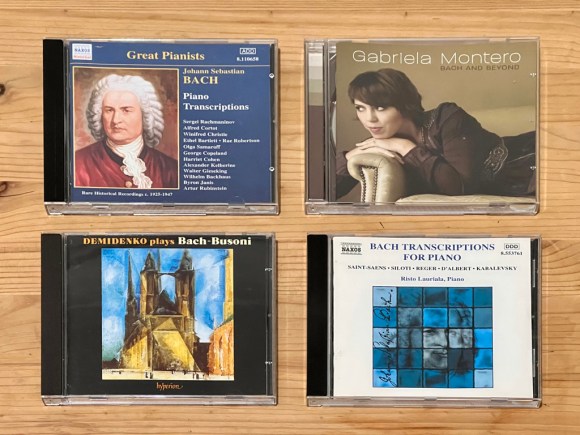
The CDs

Anyway, back to the ‘lightbulb’ moment. As I was looking through said catalogue and deciding how to use my discount code, floating over the airwaves came Wagner’s ‘Ring Cycle’. And, almost simultaneously (I think), my eyes landed on the theatre’s ‘Shakespeare Dictionary’. 💡 How about combining the two? This could be a world first: The Ring Cycle written in Shakespearean language!

Anachronisms

On New Year’s Day, 1st January 2022, I officially started the research. I was excited and looking forward to penning the ‘Shakespearean Ring’. I had a couple of German to English translations — good… Simply use the Shakespearean lexicon, etcetera, instead of contemporary English — and everyone will understand… But will they…? Where’s my red marker!

Exeunt The Bard and his contemporaries
Stabreim v Couplet

Wagner’s ‘Ring’ (or ‘The Ring of the Nibelung’ to give you its full title) is a seventeen hour opera. He, himself, sourced various versions of the epic poem, writing and re-writing the text in stabreim. He also composed the music.

Definition of Stabreim: (Ger.). A versification style based on alliteration, common in German and other north European poetry of the early Middle Ages. It was adopted by Wagner when writing his own librettos …

from:  Stabreim  in  The Oxford Companion to Music (online)

This project will be a re-working into another poetic style, the couplet, and is based on research I conducted.

Research

Definition of Couplet: two successive lines of verse forming a unit marked usually by rhythmic correspondence, rhyme, etc…

from: Merriam-Webster (online)

The first verse from part one penned recently:

The Ring of the Nibelung

📕 The Rhinegold

📗 The Valkyrie

📘 Siegfried

📙 Twilight of the Gods

Part 1: The Rhinegold

From left to right by nature’s design
Flows continuously the ready River Rhine
Lighter turquoise evenly spread
Becoming darker towards the bed
Near the floor the water dissipates
Leaving an increasingly breathable state
This vaporific man-sized space
Moves continuously and at apace
Across the floor of the riverbed
Where no man can naturally tread
Are rough rocks and undercurrent tides
And vertical caverns unimaginably wild…

Categories
Fine Art

Coat of Arms

Cleaned up scanned image
Commercial shield
Photo lab’s upload portal
Print: Fuji Fine Art Museum Rough 300GSM
Measurements
Template ready to cut out
Print cut to template
Sticking print to shield
After trimming print
Sword | Blazon | Crown
Categories
Music

Scarborough Fair

The traditional folk song, Scarborough Fair, dates back to Medieval times and refers to an old fair in Scarborough, Yorkshire. The market fair included traders, merchants, entertainers and food vendors, starting from the 14th century until the 18th century. Today, several fairs are held in remembrance of the original.

‘Scarborough Fair’ Lyrics

The lyrics in ‘Scarborough Fair’ are about unrequited love; a man trying to attain his true love. The young man requests impossible tasks from his former lover, saying that if she can perform them, he will take her back. In return, she requests impossible tasks of him, saying she will perform hers when he performs his. In the Middle Ages, the herbs mentioned in the song represented virtues that were important to the lyrics. Parsley was comfort, sage was strength, rosemary was love and thyme was courage.

Simon and Garfunkel’s Version

“Paul Simon learned the song in 1965 while visiting British folk singer Martin Carthy in London. Art Garfunkel adapted the arrangement, integrating elements of another song Simon had written called “Canticle,” which in turn was adapted from yet another Simon song, “The Side of a Hill.””

History of the Folk Song ‘Scarborough Fair’ – LiveAbout

My Version

In my re-imagined/re-composed version and recording of the traditional tune, thought was given to the costume and the videography. During the editing light balance and overall visual appearance were adjusted to convey a dreamlike, fairytale atmosphere. When I was recording the vocals it seemed, at times, as though I was fighting an invisible enemy. This gave my voice a different quality: (a) a sense of weak, youthful innocence similar to a feeling of indolence (Scarborough Fair), (b) a strong, macho/masculine presence similar to a military officer recounting events on a battlefield (Canticle).

Click here for the video: Scarborough Fair/Canticle

Categories
Fine Art

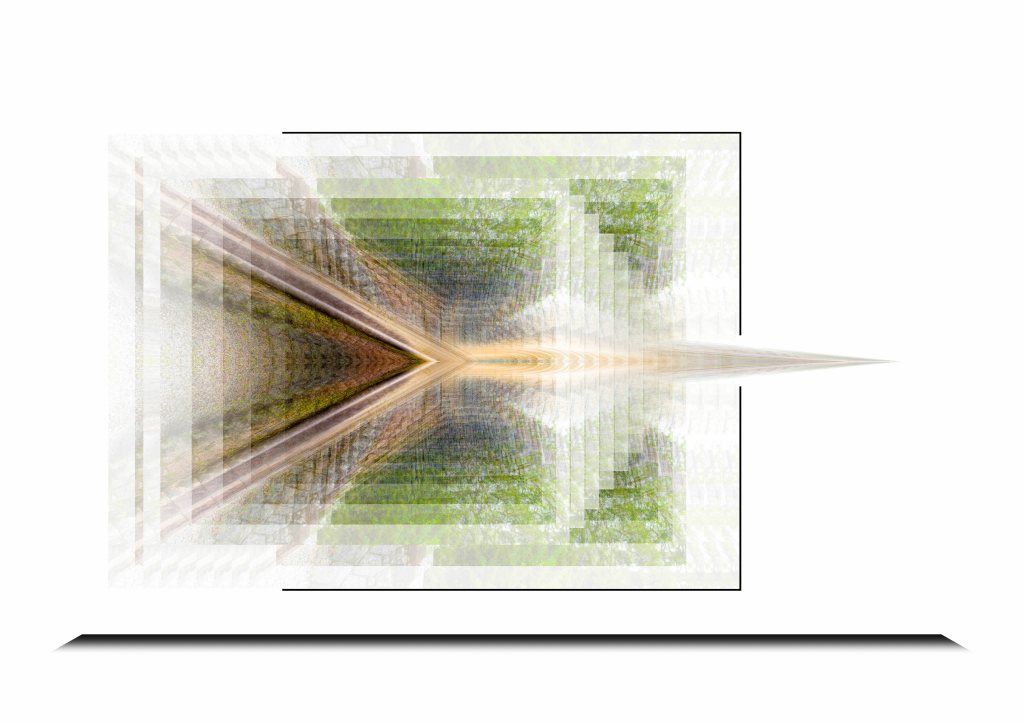
Saint Mark’s Church – Floating Quadrature (Inversion)

Dissertation submitted for the Degree of Photomedia BA (Hons)

Chapter 1 (extract)

The opening paragraph of Chapter 4 will give a taste of some of the meanings and aspects of Christian art and design.  The next paragraph will outline what type of analysis the chapter’s images will go under, which Christian ideas, history and principles occur regularly, where Peirce’s semiotics theory connects with the analysis, and how being equipped with the right knowledge can aid personal understanding and experience.

Following this, there will be some pages of essential groundwork necessary to be able to read the photographs, such as the meaning of numbers, shapes, colours, halos and auras.

The first photograph to be analysed is a stained-glass window, which is a panel (perpendicular) tracery design.  “Tracery is the term used to describe the varied forms of stone and glass decoration of the window head during the Middle-Ages…” (Dirszlay, 2001:231).  Following this, attention will be given to the three scenes depicted in the window with any related Bible references.

The next photograph that will be analysed is one representing the Erpingham Chasuble.  After its definition there will be a selection of details concerning what the design and the representation on the front communicates, and who it may have been made for.  The last photograph that will be analysed shows the top section of Bishop Fox’s crosier.  As before, there will be a definition followed by a selection of the details concerning what the design communicates.

Chapter 5/Conclusion will expand on the recipients of the messages expressed in Church art and design, how Church art and design can assist and enrich the Christian experience, and what the features of that experience are.  This chapter/conclusion will also look at why iconic art is symbolic and what it is based upon.

This will be followed by an examination of the invisible, yet visible essence of the Church.  Invisible because only the Omniscient God can see the true spiritual state of people; and visible because this spiritual state is proved, to a point, by the change in life style of people, and be photographed.  Also, the extent to which photographs of Church art and design communicates Christianity will be written about.  To finish, there will be a suggestion for possible future studies.

Saint Mark’s Church – Floating Quadrature (Inversion)

From:

TO WHAT EXTENT CAN PHOTOGRAPHS OF CHURCH ART AND DESIGN COMMUNICATE CHRISTIANITY?