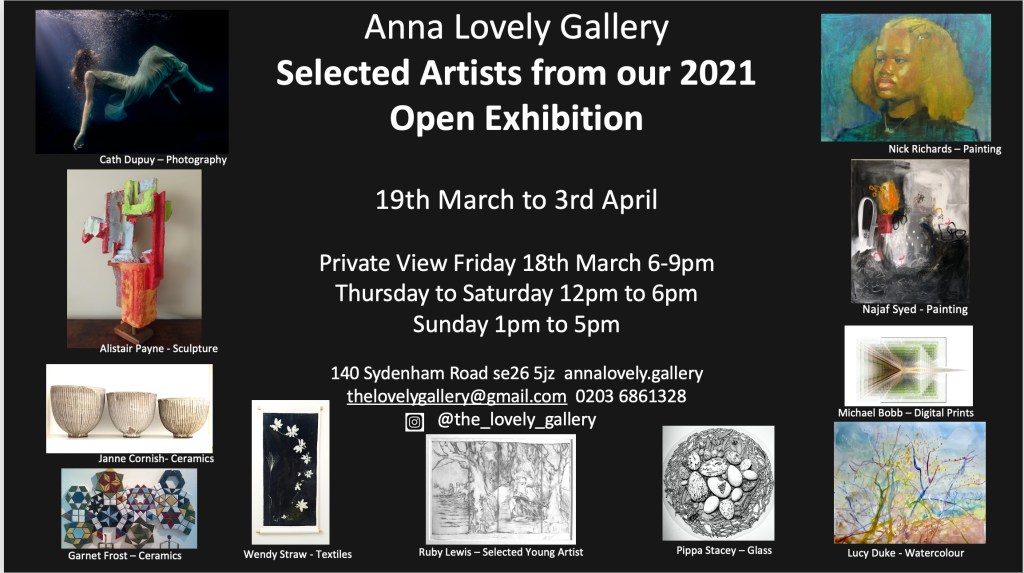
The recent art exhibition at the Anna Lovely Gallery was open for two weeks, ending on the 3rd April 2022. The Artists showing were selected from the 2021 Summer Open Exhibition. On the penultimate day I made footage and added fitting music by Mussorgsky called ‘Pictures at an Exhibition’.
This is the most famous piece of organ music ever written!
From the very first notes it demands your attention. But, was it really composed by Johann Sebastian Bach? Well, surely everybody knows it was because, after all, that’s how we came to know the piece.
However, a very small ‘however,’ one or two quarters have made remarks about this music that are interesting.
Bombastic, outlandish and downright outrageous?
Sweeping, catchy proverbs after sweeping, catchy proverbs?
And, would maestro Bach ever compose in such a style so different from all his other output?
Answering the first question, my thoughts are that it is extremely flamboyant, debonair and daring.
To answer the second question I would say that, at times I couldn’t bear to hear the piece. It sounds so like the music you would hear when you are put on ‘hold’ on a customer services call. Or even a piece of elevator music. One cannot escape the fact that it is, as the title implies, virtuosic.
And to answer the third question let me say that, all great composers have the ability to write in a wide variety of different styles — the wider the variety, the greater the genius. Whether the quieter nuances or the spicy fireworks, if one can compose without limits, one is unlimited — a master. It is my opinion that Bach probably wrote the Toccata before breakfast. A mere exercise a virtuoso could dash off to dazzle and impress anyone who happens to be within the church’s vicinity.
For this post I will be taking the first movement, the Toccata.
Recordings
Not all recordings are equal.
I have been enthusiastic and passionate about music, particularly the ‘classical’ genre, for my entire adult life, and have come to realise that different recordings of a piece can vary, one to the other — and quite a bit, too.
The piece under the spotlight here was composed for church organ, probably before 1708. There are also arrangements for orchestra, solo violin and the piano. It has been said that the moment a piece of music is re-arranged from its original, it has been re-composed.
I see the piano as the musical instrument of my choice since 1990. An eminent guitarist said a few years ago, “Whilst stringed music is for the emotions, piano music is for the intellect”. So, join me on this particular musical excursion, on the piano, with Bach’s legendary Toccata.
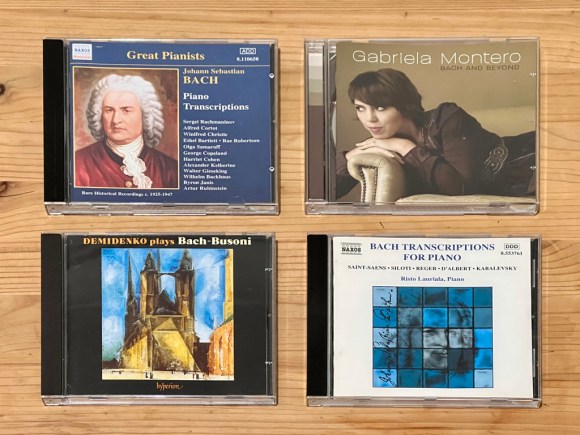
In my CD library (yes, they do still exist) are four CDs that include recordings of the Toccata on the piano (see below). Over the years I have developed a musical palette whereby I can tell within the first few bars of a recording whether it will be satisfying and pleasurable. If only I had all the ultimate recordings then I could rest! I want all of them — now!
Sheet Music
As you can see below, there are four different publications of the Bach piece in my library – all arranged for solo piano.
These publications, with the help of recordings to an extent, shows one how to play the notes. However, playing the music is an entirely different game – I love affair – making the notes leave the page and into the ears.
Music is to be enjoyed and not endured. Making music is not a mechanical process played by automatron robots, but a dance between musician and listener, between a man and a woman. The heart, the intellect and the spirit of a person are all at play. To me, it is all about communication – two-way communication.
Music is nostalgic — enjoying the past now. Music is predictive — drawing down from tomorrow and enjoying it now. Music is art.
And how does one translate two notes on a page to two notes on the airwaves? Answer: interpretation. What statements are you going to make? What phrasing are you going to articulate? Are there any emphasis you could bring to highlight a point or two? And what is the overall shape, the story you want to tell: the starting point, the endpoint, and the interim?
My Interpretation
And so to my interpretation of the Toccata from Bach’s BWV 565…
Thirty-five years ago since I became aware of the work, I am now hearing it call out to me: “Rubato!” and, “More rubato!” And sometimes I never pay the stolen time back! As I have been familiar with the piece for such a long time, I am instilling more musicality into performances — which, of course, is inseparable from elements of my personality. And so, naturally, I have made recordings – just for fun.
Section 1
The last recording I made brought with it a surprise. Up until that date I had always played the opening with the same notes. But, for the first time it dawned on me to play the same passage with extra notes. I tried it. And, it worked! With these new notes came a new interpretation on how they should sound. In short, there is a deliberate slowing down of the opening, together with increased volume dynamics, and becoming more emphatic as the music descends down the keyboard into the sonorous depths of D minor… And that’s just the opening!
Look out for another exaggerated detachment — this time two notes. And the music continues…
Section 1 video
Section 2
In this section I draw further on my feelings on how poetry should be performed. This is played out with more manipulation of the timings. When, as I tell the story, I repeat a particular chord sequence, the chord sequence anticipates, predicting that something different is about to happen — a new scene, as it were, is just around the corner. This predictive text is not written in the score but comes from my memory of an old recording on audio cassette tape played on a church organ…
Section 2 video
Section 3
Much more rubato and dramatic storytelling…!
Enjoy!
Section 3 video
My own review of my own performance? Stately. Pronounced. Flights into the ether? Faithful to the term ‘toccata’. Organistic.
There will be an art exhibition taking place in Sydenham, London starting this weekend. The private view will be the Friday evening before the show officially opens. All are welcome!
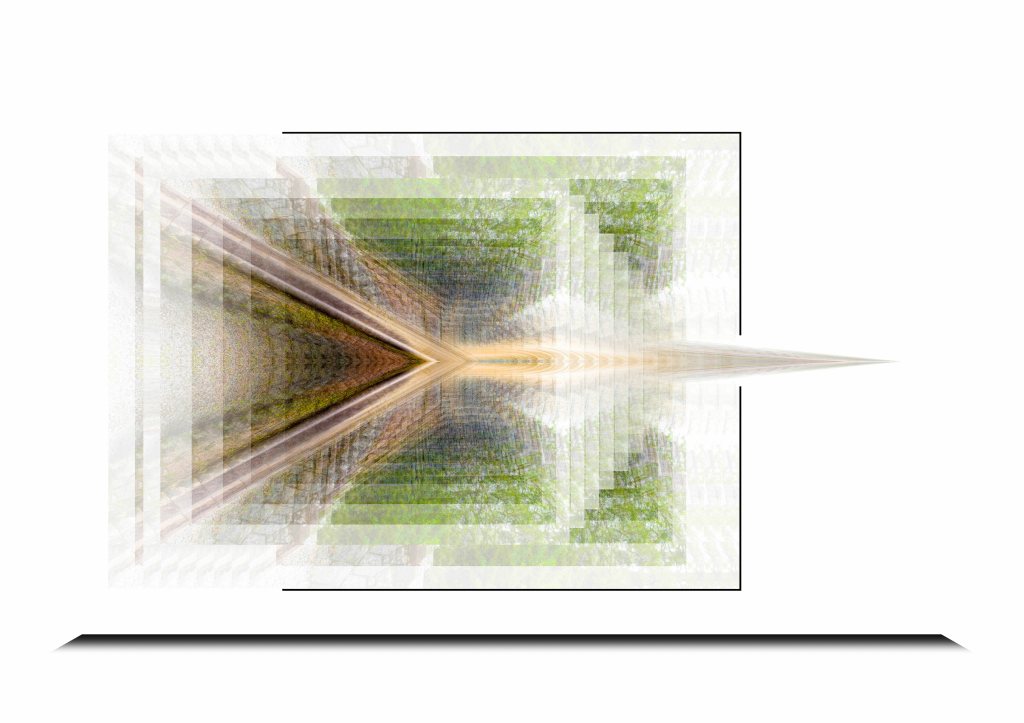
One of the pieces I will be exhibiting is titled: St. Conan’s Arrow. This piece of fine art started life as an image captured with my Nikon DSLR on a photography tour that included St. Conan’s Kirk, Lochawe, Scotland. Please click here for the church’s website. On their site you will discover fascinating information about this ‘Hidden Gem’. Put this destination on you itinerary the next time you visit the Argyll and treasure the experience!
When I visited, I witnessed how unique this location, architecture and spiritual atmosphere really was. And, as one does, I took many photographs; I was in my element. Capturing as much as I could, whilst obeying the holy reverence that, to me, was so very evident.
About the Art
One of the many architectural features of this ecclesiastical structure are the flying buttresses. The image below is a manipulation of just one composed photograph of an aspect of the church building. In this geometric abstraction created in Photoshop, you will be able to see the flying buttresses – but only if you squint! The green colours and shades are the surrounding deciduous foliage. The entire image has been enhanced, going through various stages of post-processing.
Title: St. Conan’s Arrow
Specifications and Adjectives
The next generation
Photoshop created
Award-winning laboratory
Crémé de la crémé
Church art
Apotheosis
ne plus ultra
Emotional
Culture
Metallic photographic paper
6mm acrylic facemount
Size: A1 (other sizes available)
6mm acrylic facemount
Also on display will be three other A1 pieces from my Well-Tempered Church Catalogue, namely:
Inexplicable Fancies
Paul’s Journey To The Other Side
Testament Of Expression
I have applied many hashtags to the pieces from the catalogue, but here are just three: Christian, Intelligent and Exquisite – in that order. When I look at my art I have an encounter: my vision senses quick rays of brightness that invades my being; I feel them somewhere internally – it’s a kind of love affair between my art and myself. The art, my art, changes me.
Anna Lovely Gallery
Last year, 2021, I displayed one piece in the Open Summer Exhibition which took place in September that year. There were over one hundred Artists displaying one piece of their art. After the exhibition I went to the gallery to collect my piece. To my joy and astonishment, the gallery owner informed me that my piece was chosen as best in category(!) Not only was I not fully aware that I was entering a competition, but a category had been created just for my piece of art! What a surprise and a delight! The category was: Digital Print. Questioning the boundaries of art…? Possibly. Inventing a genre of art beyond what has already been established…? Evidently so, but not intended from the outset. Raising the odd eyebrow or two…? Well, they certainly amaze me – and I’m the Artist!
Although my art has been placed in the Digital Print category, which applies to two dimensional media, these pieces have a second media: the facemount. The facemount is additional, and part of the art, effectively transforming the piece into three mentions. Therefore, I place the art into another category: Multimedia.
How about other people’s reactions to the pieces? When I showed someone an A4 size version, they took it into their hands and just looked… and for quite a while. What will your reaction be when you encounter these pieces in real life? Allow nothing to separate you from them except air for the full effect.
And so, here are the Selected Artists from the 2021 Open Exhibition showing in 2022 from this weekend for two weeks.
It was around the time of the Chelsea Flower Show one year and I was walking along the path in my front garden. Although it was windy, the blue sky just held its own on that sunny afternoon in May. My eyes noticed something moving in the breeze – it was the flowers. It was, as if, I saw the flowers in that light for the first time – dancing.
How many decades had I lived here…? How many flowers had I seen grow, flourish and change with the seasons in my garden…? And how many days, weeks and months of beautiful summer weather had I witnessed…? Not forgetting the aggregate of creatures over a couple of decades, or so, that may have happened upon them…?
There was a bee or two doing what they do best in such natural environments, just buzzing about from flower to flower. These were no ordinary bees – they were my bees!
I was compelled; out came my phone. For the next however-long, I filmed them: the bees… the flowers… and the breeze…
Early the next morning when my eyes had barely opened, I was thinking about this scene. My mind was fixated; I could not stop thinking about it all; I was obsessed; over and over and over: the bees… the flowers… and the breeze… Compulsion grabbed me again and I stole my pen. For a good, long while I toiled: trying this here, something else there, moving the other somewhere else… And then, two hours later, I struck gold – I wrote the last word. Phew! It wasn’t until I returned the pen that I could once more live a normal life. I was satisfied. I was quenched. I was full. And I was free from my malady – safe. The only thing I needed to do was have breakfast – and so I did. And continue with my day.
“Swaying, Swaying In The Breeze
Swaying, swaying in the breeze
Dancing, dancing beneath tall tree
Moving another way in slight air
So handsome, so pretty, so fair
Hues and shades, rare and fine
What invention, what design…”
– first verse
Just for a moment or two, let your imagination go and think of long ladies with long, wavy hair, wearing long dresses, during long, hazy summer days dancing in circles beneath… a tall tree…
“The assignment, if you choose to accept, is to write a poem about fishing.” Well, that wasn’t quite the directive from Her Majesty’s Secret Service but by a local poetry collective some years ago. To be more precise, a person from the group Poetry Hour, which meets bi-monthly at Croydon Central Library, selected the topic of ‘sport’ that we could write about for the next meeting.
Now, I’m not really a sporty sort of person but very keen on most other aspects of health and fitness. I hadn’t a clue what to write about for a week or so until I was engrossed in another intensive sport akin to skydiving – the sport of ironing! There I was pressing the creases and my mind caught… a fish! I had never, ever, been fishing and so I went to the local angling store to conduct some research.
While I was there, I asked the sales assistant about the sport and bought some fishing line, a fly, a hook and an angling magazine – these would be visual aids that I would use during my reading. At least that was my intension.
The poem may, or may not, have been written with a tongue in my cheek.
“Gone Fishing
It’s 3:15 am and I’ve just packed my lunch and kit
The predictive seaweed looks clammy as I check it
The shipping forecast confirms, rain is on the way
And hovering around minus two for most of the day…”
first verse
For the video productions of the poem there was only one choice of music that sprung to mind: The Trout by Franz Schubert. In my recording, I have brought out the jolly experience of fishing! Furthermore, there is a surprise at the end of the full length videobook version of the poem.
To wet, whoops, whet your appetite here is the first verse from the videobook: Gone Fishing
Wrynose Pass is a mountain road in an English National Park called The Lake District. It has been described as Britain’s most difficult road.
During a photography holiday in this part of England I was coming to the end of a particular day. I had been driving far and wide to many locations with my camera, rural and otherwise.
The time was approaching sunset when I reached Devoke Water, the last location before returning to the B & B. Although I had been to this lake before, this second visit was a trifle peculiar… What was not different was the voices of the angels and the view of the lake itself, made extra special by the setting sun with all its colours.
After the photography I returned to the car and started to make my way back but, unlike the previous occasion some years earlier, the journey was marked by a thick, nocturnal atmosphere – and I had no idea what lay ahead.
The location I chose to film this poem was an almost forgotten road somewhere that reminded me of Wrynose Pass… but where’s the car!
The first verse:
“Wrynose Pass
I’m on my way back to my lodgings
Not long, I hope, ‘till I’m safely back
I set the SatNav and follow its commands
It’s getting darker and will soon be pitch black…”
The music I chose for the video is titled: Sonata quasi una fantasia (translates to: Sonata in the style of a Fantasy). Although the sonata is also known as the Moonlight Sonata, I wanted to bring out the drama and sense of fantasy when I recorded it on my piano. The recording of the music also went through a mysterious and eventful journey. The morning after I had made the final edit, I played it back on my HiFi. Immediately after this I turned the radio on and exactly the same movement from the same piece was being played.
Here is the first verse from my videobook: Wrynose Pass
‘I Have A Nikon Camera’ is an art poem about a camera which also tells you a lot about me!
The first verse reads:
“I Have A Nikon Camera
I have a Nikon camera
That captures photons new
The light sensitive sensor
Is sharp, accurate and true…“
Let’s wind the clock back several years…
There was a time in my life that lasted decades when I was passionate about all things photography. I studied it acquiring many qualifications, amassed stacks of magazines, joined a camera club and three photography organisations, and purchased a good quality Digital Single Lens Reflex camera.
When not in use, I would store the camera in the airing cupboard with other items. Just above the cupboard is the cold water tank. One day this water tank developed a leak that saturated everything in the airing cupboard – including my Nikon camera.
Soon after this I found myself writing poetry. Up until then my poetry writing had only been now and again, on the odd occasion. But now, more frequent poetry started emanating from me; I was falling in love with the process of writing poetry! At the time, thoughts like “this is going somewhere” were floating around my mind.
As high level photography had been evident in my life for a long time, writing poetry about it came quite naturally. There was a transfer from one type of creativity to another. Further still, an easy leap to producing videos of my poems – including this one.
The video version of this poem is an arthouse production, with music by J. S. Bach recorded on my acoustic piano. All visuals and audios have been artistically altered during the editing stage.