It is January 2024. I am at church, my local church – sometime before the annual ‘Week of Prayer’.
With a whole twelve months stretching ahead of us, we begin the year before God. I cannot think of a better way to start the year than seeking God in prayer every day for a week as a church and as individuals — also praying for our community, our nation, and the nations. Praying to God at this time of year, and in this way, is so special. I always feel refreshed and sanctified after the Week of Prayer.
The prayer of a righteous man is powerful and effective
James chapter 5, verse 16
Only He holds the keys to the future.
Leap Year
I engage in conversation with someone from church. As we talk I find myself saying, “I am in love with someone”. This is the overflow of my heart. The response, “Well… it is Leap Year!”. Traditionally, a woman can ask a man to marry her on the 29th of February. ‘Normally’, it is the man that proposes to the woman. I hatch a plan: I will propose to my sweetheart on that very day.
M S
I have known M S, my sweetheart, for several years. We first met online on Christian Connection in 2016. I particularly liked her strong Christian Profile. A strong Christian woman with a strong Christian man would be a great match! We could talk about God to each other for a very long time!
Super Spirituality
One day I was reading my Bible and listening to some music. I reached a particular point in that reading at the same time a particular piece of music began to play. As I finished the reading, this piece of music finished at the same time. I took a pen and began to write down what had just happened. As I was writing, my pen dried up. As my pen dried up, M S telephoned me for the first time, and we had our first live conversation. Only almighty God could have orchestrated such a sequence of occurrences. This was super spiritual activity! No man could do what God did! Supernatural activity is God’s hallmark in my life. Sometimes, I feel that there is only God and I in this world — and I burst exclamations and thanksgiving to Him!
Over the years, M S and I roughly sketched out ideas for our future. I am always full of dreams and ideas of a fanciful love nest, coupled with travelling the world in the name of Christianity.
Erm…
The end of February approached. And whoever could read my mind knew what I was going to do: propose to M S.
The day had arrived. When I woke up that morning, it appeared that someone had ambushed my plans; all my intentions, somehow, were frustrated and/or thwarted.
“It is mine to avenge; I will repay,” says the Lord
Romans chapter 12 verse 19
Somehow, it felt more like a postponement. Hope deferred makes the heart sick.
I turned to music composition.
At the time, I was about halfway through composing a series of vocal chamber music pieces.
Favourable Reviews
In September 2023 last year, I produced an album of classical music – all composed by myself. I use a top notation software recommended by someone who is admin for an international contemporary classical composers’ group on social media. He also recommended the necessary playback software. Up until that time I was using a low value app, but now I was going professional with the intention of gaining commissions. The high-quality album I had produced was my ‘calling card’.
Around this time there were discussions happening at my church about the desire for more biblical worship songs. Someone even suggested these New Songs could be written together with orchestral arrangements. I received that as an unofficial commission.
Go!
With this fixed in my mind I set about composing for smaller vocal ensembles that could easily be orchestrated. By the end of the year, I had two songs. And by February I had two more. These songs were written in the classical style.
Lyrics
The text for these songs were based on poems I had written about my geometric, abstract artwork created using image manipulation software. Originally, they started life as composed photographs of church buildings. Now, they were abstracted. There are now forty of these artworks in my catalogue. And so, naturally, being a Photomedia Practitioner I made videos of the art.
Each church art piece and video had a title. From this I wrote a poetic representation. This literature formed the basis of my vocal chamber music project. On the morning of Leap Year Day, I decided to draft in another poem not on my original list. In direct reaction to thwarted love I added: The Slayer.
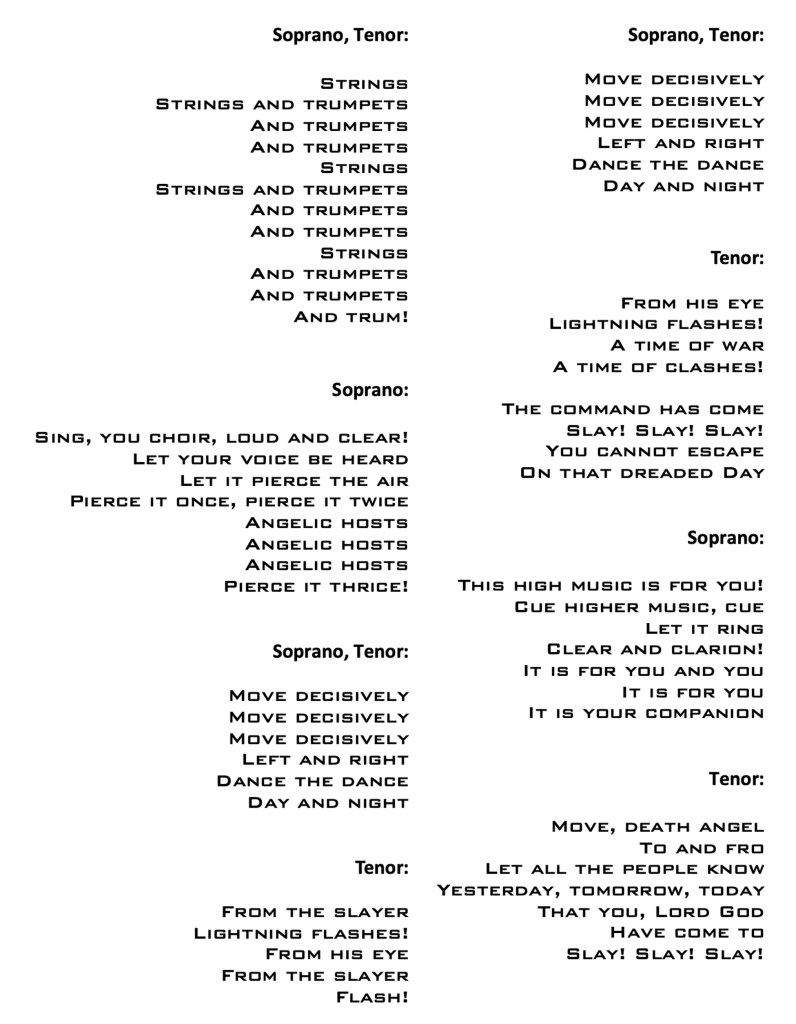
Here is the poem reworked as a song:
Analysis of Lyrics
In my video of the artwork I chose: J. S. Bach’s Christmas Oratorio, Part 1, For Christmas Day, Chorus. The music opens with timpani drums followed by the playing of stringed instruments and trumpets. In my composition, soprano and tenor literary sing the words: Strings and trumpets.
This is followed by solo soprano singing, in idiomatic style, a description of what the chorus sounds like.
Next, both soprano and tenor sing a description of how the object, which looks like a tank, behaves in the video.
This tanklike object, or Slayer, has an eye that emits flashes of lightning – so the tenor sings. This is followed by manoeuvres across the screen – as sung by the duet.
The tenor then sings of what can only be described as: a time of battles in the heavens where God directs this death angel to mercilessly slay. Only the holy will escape that future apocalypse.
The soprano then points the judgement finger, singing that expiration will be accompanied by high music. The singing of her last line, “It is your companion,” is chilling, because it is delivered in a quiet, low tone – a complete contrast – to underpin the seriousness and finality of the unfolding events.
The tenor finishes by telling us that this Death Angel is obeying God’s command.
A Coffee Morning Concert
After I had drafted these words that morning, I went to a solo piano recital at a church a couple of miles away. Maybe I would get some inspiration as to how to set this down as music.
At the concert in the tea area, conversation was light-hearted and jovial. When the concert was due to start, I sat next to someone who happened to be an art collector. Although I did not recognise her, she recognised me as an artist. A few years ago, she saw one of my art pieces at an exhibition and made the purchase. Naturally, I was delighted.
The concert was an hour long. During the playing of one contemporary piece, I began to hear in my mind’s ear how I was going to compose the music for The Slayer.
As I was leaving the church, I found myself talking with other music appreciators – one of whom was also a pianist. We smiled broadly during conversation, and likewise as we parted.
Analysis of the Music
The vocal chamber ensemble for this series is made up of: Violin, Soprano, Tenor and Piano.
After lunch I started at the piano, initially striking chords and notes that were not in any key. The scratchings I made on manuscript paper were transferred to computer software where I further developed my ideas. The finished piece was a three-part fugue where the violin provided the third line. The violin also answers subjects with further questions. The vocals bring dissonant, hair raising, meaty asides to an otherwise tight and skinny instrumental Dux and Comes, i.e. ‘Leader’ and ‘Companion’.
So, what is a fugue, what does it mean? It is a French word that means ‘flight’. A fugue can also be described as two jumbo jets refuelling in mid-air, one slightly behind the other. Or it can be likened to a chase. Musically speaking, a fugue is a piece of music where two or more independent lines of music entwine one another, one starting later than the other. Of course, there are rules to fugal writing – but the most prolific exponent of the form, J. S. Bach, was notorious for breaking them!
Two examples of fugues: 1) The famous Toccata and Fugue by J. S. Bach, BWV 565. 2) The nursery rhyme London’s Burning.
A Second Layer
The Slayer is composed with 5 beats to the bar. There is also another famous piece in this time signature. It was used decades ago in War of the Worlds adaptations that terrified people. It was also played to young children in a setting which caused them to cry. The piece was Mars – The Bringer of War from The Planets Suite by Gustav Holst. The Hollywood composer John Williams also re-worked the piece, transforming it into Star Wars – particularly the dramatic concluding bars.
A Biblical Perspective
Moses was God’s chosen man to lead the Israelites out of Egypt. He went to Pharaoh asking him to release the Hebrew slaves from Egyptian bondage so that they could worship God and live in freedom in another land. Pharaoh refused. Not once, but every time Moses pleaded. Every time Pharaoh said, “No,” God sent a plague. The final plague God sent was death delivered by the Death Angel. This Angel would slay the firstborn of every household. Prior to this deadly plague, Moses was instructed to tell the Israelites to put the blood of a lamb on the door posts and lintels of their homes. When the Death Angel saw the blood of the lamb, he would pass over, and not bring death to the inhabitants. Hence, the Jewish Passover – from which we celebrate Easter. Jesus Christ was raised from the dead on the Sunday after Passover.
The Video
The full title of this composition is: The Slayer – Apocalypse with Fugue Form. I could only have arrived at this definitive during the making of the video. This is a futuristic video with foundations in the past.
The final, finished video is quite striking in terms of editing, special effects and transitions. Fluke, after unbelievable fluke, after unbelievable fluke occurred in the process of making this video that a probability mathematician would find difficult to explain. I read once that occurrences like these gives rise to an intelligence beyond human intelligence.
Love
I need to give and receive love as God designed. The obstruction of this led me to write the words of this song, to compose music hitherto I would not consider, and be the recipient of happy accidents.
After I finished making the video I said to myself, “Only the pure in heart will understand”.
So…
The score is now available to download from my website for interested peoples and musicians, at Michael Bobb Productions. Audio and video recordings:
Vocal Chamber Music – Violin | Soprano | Tenor | Piano
I use one distributor who distributes my audio to a suite of platforms around the world.
As for different types and sizes of ensemble, yes, The Slayer could enjoy different expressions. A string quartet would be interesting to watch, for example. But, a full-size orchestral sound may give it a different edge, a different understanding.
At the time of composing this piece, it felt like a departure from my usual style. However, since then I have written pieces that could easily wear that label. In fact, every piece in my vocal chamber music series has individuality and character – even idiosyncratic personalities! Above all, they are art.
Here is a list of the ten Vocal Chamber Music pieces in alphabetical order. So far, eight have be completed.
Beethoven’s thirty-two piano sonatas have been called, by a few, the New Testament of solo keyboard music; J.S. Bach’s Well-Tempered Clavier, the Old Testament.
Book 1
Let’s get to the matter of the topic: performance. For over thirty years I have been listening to recordings of the 32. Within the music, and between the notes, are essences of Beethoven and his classical/romantic world. Beethoven’s family and family life, and educational development; his forebears and teachers; his own established life as a pianist and composer; antiquity and culture of his time; his muse and acquaintances; even war and politics of his era — all made the man: Beethoven.
Book 2
Beethoven’s early solo keyboard sonatas were written to be played on harpsichord or fortepiano — this includes sonata no. 8, op. 13 named grand sonate pathétique by the publisher. In my opinion this is because of the soothing, gentle, rocking and emotionally atmospheric elements of the second movement. As harpsichords do not have a sustain pedal, I have played this particular music without pedal — and, to my delight and wonder, it is more poetic. All my sheet music scores shows pedal.
Several years ago I went to Robert Morley & Company based in Lewisham, London looking for a piano. I had a collection of scores as test pieces. Piano after piano were left wanting. And so I took a leap: I tried a piano out of my bracket. It was Beethoven; I heard Beethoven! The piano was a British made Broadwood. Needless to say, Broadwood gave one of their pianos to Beethoven. Could the truth of the 32 be heard in a Broadwood?
Earlier today I received a subscribed email that linked to an article on the thirty-two sonatas. All extracts played on pianofortes. All eminent pianists or musicians with fine interpretations. All Beethoven…?
Michael Bobb – Artist • Author • Occasional Composer
Friday 26th August 2022
This recording includes Sonate Pathétique — without pedal. It is played on an Elysian piano, not a Broadwood. Listen for the poetry… and enjoy the poem!
So, what is a Cantata? A Cantata is a musical work composed for the voice. It is approximately twenty minutes long with smaller movements for solo voice, chorus and instrumental accompaniment — sometimes all three.
Church Cantatas, aka Sacred Cantatas, are intended to be performed during Christian liturgy.
What is the difference between an Opera and a Cantata? As a Cantata is a vocal work, mainly during the C17th and C18th, an Opera is a theatrical work combining drama, music, song and sometimes dance.
A few years ago I was online scanning the concert listings at a world-class venue in London. On this particular occasion I was looking for small scale music-making. The Baroque era is a favourite of mine, and I chose a recorder and theorbo programme.
On the day of the concert I was early, and so decided to spend some time in a book shop. Afterwards, I went to the concert hall and started my packed lunch. Before I could finish it was time for the concert to begin.
During the concert sometimes the instruments played together, sometimes they played solo. For one recorder solo, the recordist played two recorders simultaneously! When the theorboist played solo pieces, one of them was introduced as a passacaglia – which, to my amusement, collected philistinic giggles. If only the pictures of musical aristocracy on the walls of the concert room had ears of flesh!
This poem, The Known Great Composer, is about the concert. Head and shoulders above, one composer and his music made my whole time in London memorable. Memorable for the right reason – music.
No prizes, but if you can guess the Great Composer I don’t mention, you are a winner! Clue: Imagine the accompanying music in this clip being played two octaves lower on a solo cello…
First verse
“The Known Great Composer”
“The window blinds close
The stage lights are adjusted
Two musicians walk on stage
And we welcome them warmly…”
On the way home, I happened to see someone I knew. We talked for a while, and I expressed that I would be writing a poem about the concert. By this time, my mind had already begun putting the poem together.
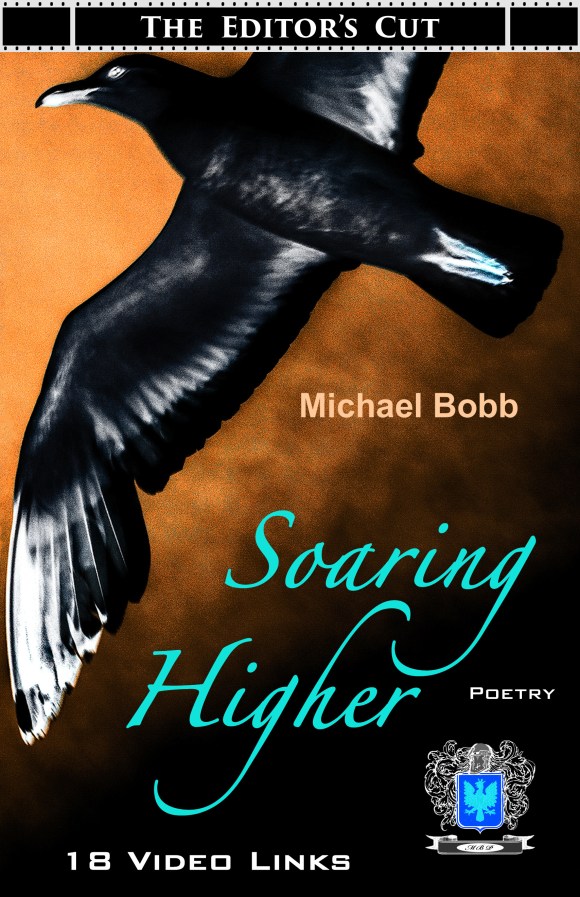
Furthermore, before arriving home, I visited a local art gallery and talked more about poetry to the exhibiting Artist, referencing the couple of books I bought earlier that day written by the Poet Laureate.










 Splashes of Ink