

“From left to right by nature’s design
Flows continuously the ready river Rhine
Lighter turquoise evenly spread
Becoming darker towards the bed
Near the floor the water dissipates
Leaving an increasingly breathable state
This vaporous man-sized space
Moves continuously and at a pace
Across the floor of the riverbed
Where no man can naturally tread
Are rough rocks and undercurrent tides
And vertical caverns unimaginably wild.“
A quirky poem based on the imagery from last week’s blog!
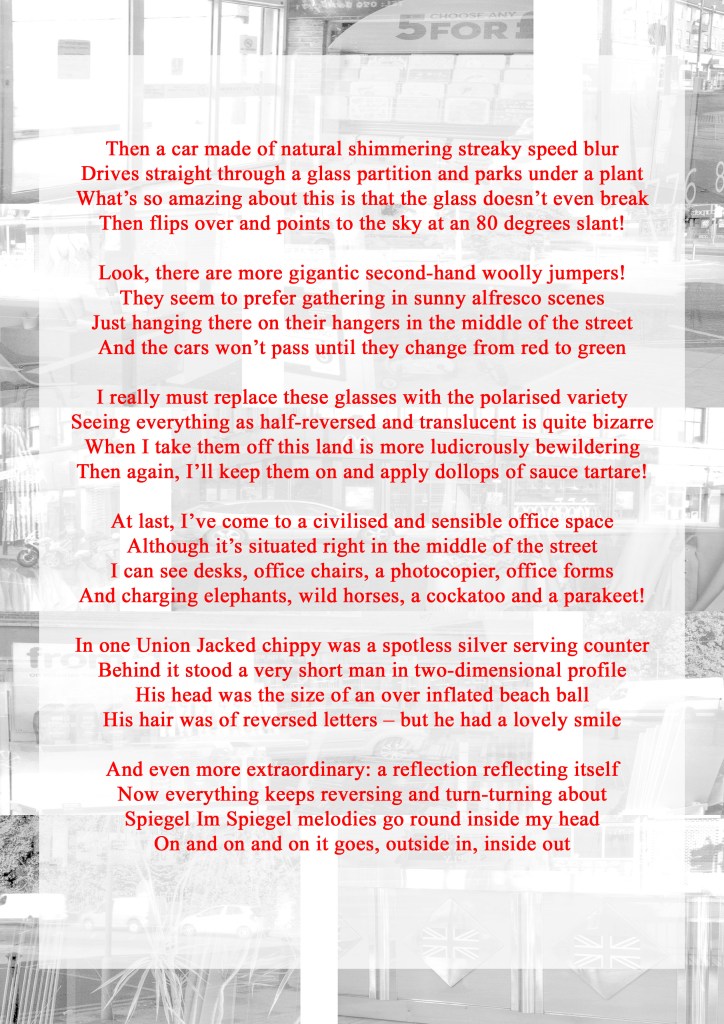

Last week’s blog:
Click ALISON – Daughter of Alice

GOD CREATES was written with the sky in mind and appears in my first book. It was one of the poems that marked the start of an increase in my poetry interests following water damage to my Nikon DSLR camera. In the poem, the second person of the Trinity makes an entry, is crucified, rises from the dead, rises to the skies and returns from filling the universe to be the bridegroom at His wedding feast.
This is the only poem I have written where the title is in capital letters. Can one imagine writing anything of this nature and not use capital letters? For me the answer is: “No”. Even music I have composed on this subject has received the same treatment: a vocal chamber piece, a solo piano piece, a choral piece and an organ piece. These musical pieces, by and large, I estimate are falling within the category of virtuosity.
My GOD CREATES poem also retains, on reflection, elements of virtuosity:
I am sure these numbers mean something to somebody, somewhere!
Would there be poetry if there was not music? Or, should that be: Would there be music if there was not poetry? I hope your happy conclusion has considered at least one of my poems. Perhaps this one?
G. F. Handel (1685 – 1759), Suite Nr. 4, Sarabande. The stately pomp and majesty of this Spanish dance fitted well with the subject matter of the poem: God and God in the act of creating. The rhythmic structure of the music agrees with the rhythmic structure of the poem.
Handel wrote the music for harpsichord, originally. On this recording I am playing it on my once John Broadwood & Sons piano.
Cecilia Bartoli
As everybody knows
and can plainly see
Is not a saint
Her falsetto warblies
Excites your lows
and mezzo frequencies
Dispelling every complaint
But a Saint — no
But a soprano — yes
and harmonising lows
This is her gift
Coloratura — yes
Beatification — no
but with songs to bless
An intellectual wit
Saint Cecilia the Christian Virgin
Patroness of music and musicians
Her feast day today so begins
Concerts and festivals this occasions
Musicians played on her wedding day
She sang in a heart to the Lord
Her song was guided by a mightier way…
The Holy Spirit. The holy sword.
22nd November 2024
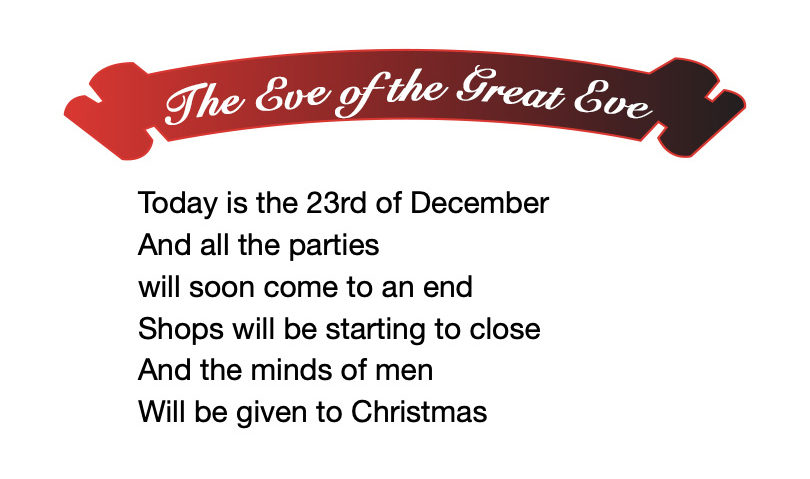
Christmas
In two days’ time…
*| A poem *|

Amen, we say, God bless you, ma’am
Reigning on the throne 70 a yarn
Serving steadfast and steady, and so calm
Our queen has made the record book
All eyes to her this day will look
Celebrate our world-class monarch
Head of the Commonwealth lands
Sovereign of the Garter, and
Supreme Governor of the Church of England
750 holiday cards issued every year
1,500 puddings to employees far and near
Philanthropic activity beyond compare
Her first corgi was called Susan by name
A lover of horses and the equine game
And owns unmarked mute swans on the Thames
Her Royal Highness and Majesty
Is also a lover of photography
And taking pictures of her family
To Scottish dancing she is partial
Hosting balls at Balmoral Castle
And Highland cuisine as traditional
Christmas message broadcast on the day
Telegram message on your 100th birthday
And media message honouring citizens – hooray!
Serving steadfast and steady, and so calm
Reigning on the throne 70 a yarn
Amen, we say, God bless you, ma’am!
Music Maestro!
Four short poems about J. S. Bach’s music.
Limerick 1
An ecclesiastical cycle.
“J. S. Bach’s Church Cantata oeuvre
Is really quite pious and pure
The melodies are holy
And so are the harmonies
For 3 liturgical calendars, not 4”
So, what is a Cantata? A Cantata is a musical work composed for the voice. It is approximately twenty minutes long with smaller movements for solo voice, chorus and instrumental accompaniment — sometimes all three.
Church Cantatas, aka Sacred Cantatas, are intended to be performed during Christian liturgy.
What is the difference between an Opera and a Cantata? As a Cantata is a vocal work, mainly during the C17th and C18th, an Opera is a theatrical work combining drama, music, song and sometimes dance.
Limerick 2
The Composer’s sewing machine!
Limerick 3
A poem for Count Kaiserling.
Limerick 4
A contemporary instrument of the viola da gamba.
For full-length videos of my poems, see below:
18 poems from the paperback
Apple Books:
A few years ago I was online scanning the concert listings at a world-class venue in London. On this particular occasion I was looking for small scale music-making. The Baroque era is a favourite of mine, and I chose a recorder and theorbo programme.
On the day of the concert I was early, and so decided to spend some time in a book shop. Afterwards, I went to the concert hall and started my packed lunch. Before I could finish it was time for the concert to begin.
During the concert sometimes the instruments played together, sometimes they played solo. For one recorder solo, the recordist played two recorders simultaneously! When the theorboist played solo pieces, one of them was introduced as a passacaglia – which, to my amusement, collected philistinic giggles. If only the pictures of musical aristocracy on the walls of the concert room had ears of flesh!
This poem, The Known Great Composer, is about the concert. Head and shoulders above, one composer and his music made my whole time in London memorable. Memorable for the right reason – music.
No prizes, but if you can guess the Great Composer I don’t mention, you are a winner! Clue: Imagine the accompanying music in this clip being played two octaves lower on a solo cello…
“The Known Great Composer”
“The window blinds close
The stage lights are adjusted
Two musicians walk on stage
And we welcome them warmly…”
On the way home, I happened to see someone I knew. We talked for a while, and I expressed that I would be writing a poem about the concert. By this time, my mind had already begun putting the poem together.
Furthermore, before arriving home, I visited a local art gallery and talked more about poetry to the exhibiting Artist, referencing the couple of books I bought earlier that day written by the Poet Laureate.

This is the month
When they say that it rains and pours
Down come the showers
From heaven’s open doors
But in-between the cascades
There are beams of sunlight
Shining through clouds
Heavy laden and fluffy white
This is the month
When the daylight grows longer and longer
With the sun rising earlier
And setting later and later
There is also a change
In the quality of light visible in the atmosphere
This phenomenon only happens
Once in the northern hemisphere
This is the month
When spring is well and truly here
It’s time for leaping of the lamb
And the young deer
Buds are prising open
Seeds and bulbs germinate
O’ the splendour
Of nature’s natural nascency about this date
This is the month
That brings high tides to our shores
As the moon orbits closer
And waxes more and more
These signs are where
The Jewish people take their Passover
And from where Christians
Take the major holiday called Easter
There is nothing like Eastertide
Celebrating a fantastic event
It happened 2000 years ago
And I, in a sense, was present
The most spectacular display
Of God’s agape love
Crucifixion and Resurrection
The only plan from above
On a Friday God laid sin on His Son
The sin of men nailed to a cross
He crucified the sinless Lamb
And took away our dross
On a Sunday Christ is raised
And we are raised with Him
This same Resurrection Power
— The Spirit — is at work within
And now we can live righteously
The old has gone, the new has come
Spreading the Good News Gospel
Of what Jesus Christ has done

 Splashes of Ink