
Antonio Vivaldi: Gloria in excelsis Deo


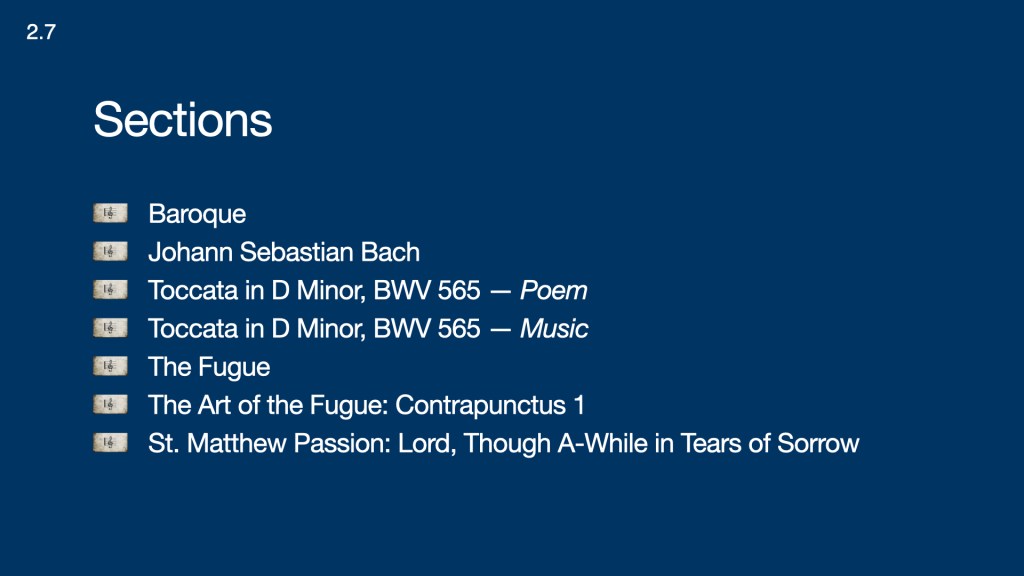

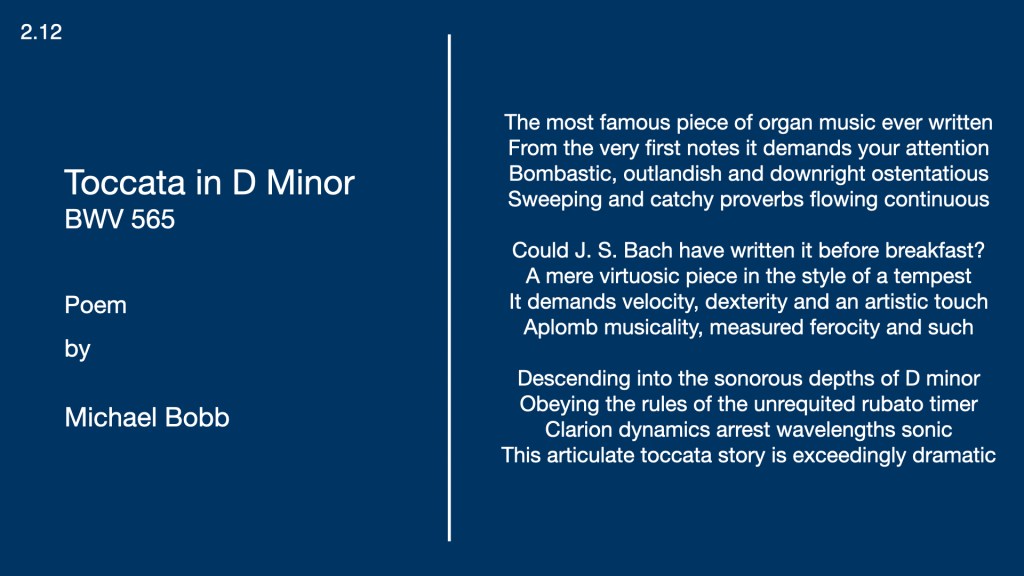
Johann Sebastian Bach: Toccata in D Minor BWV 565
Johann Sebastian Bach: The Art of the Fugue, Contrapunctus 1
Johann Sebastian Bach: Lord, Though A-While in Tears of Sorrow from St. Matthew Passion


Antonio Vivaldi: Gloria in excelsis Deo
Johann Sebastian Bach: Toccata in D Minor BWV 565
Johann Sebastian Bach: The Art of the Fugue, Contrapunctus 1
Johann Sebastian Bach: Lord, Though A-While in Tears of Sorrow from St. Matthew Passion
Richard Farnaby: Fain would I wed


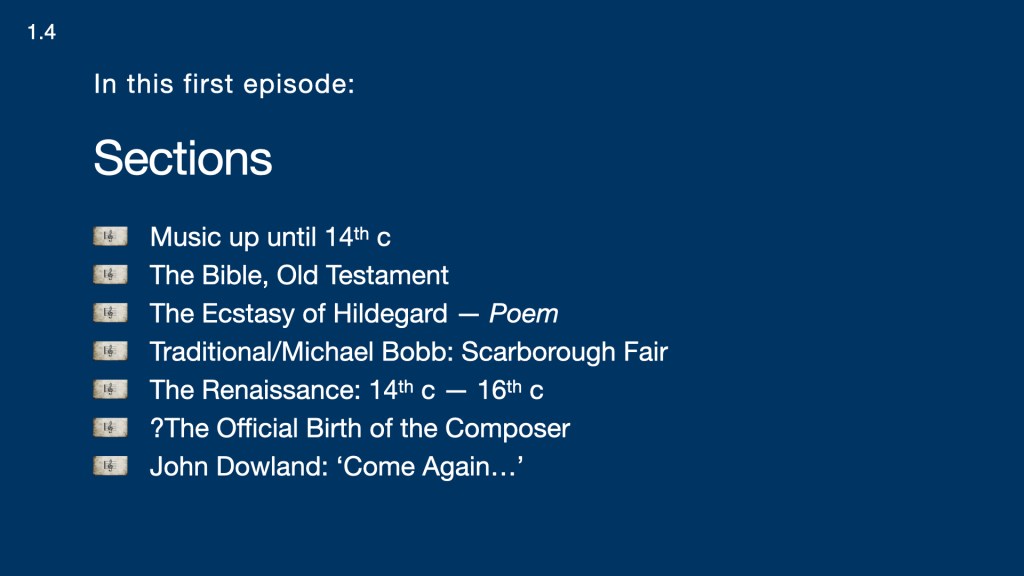
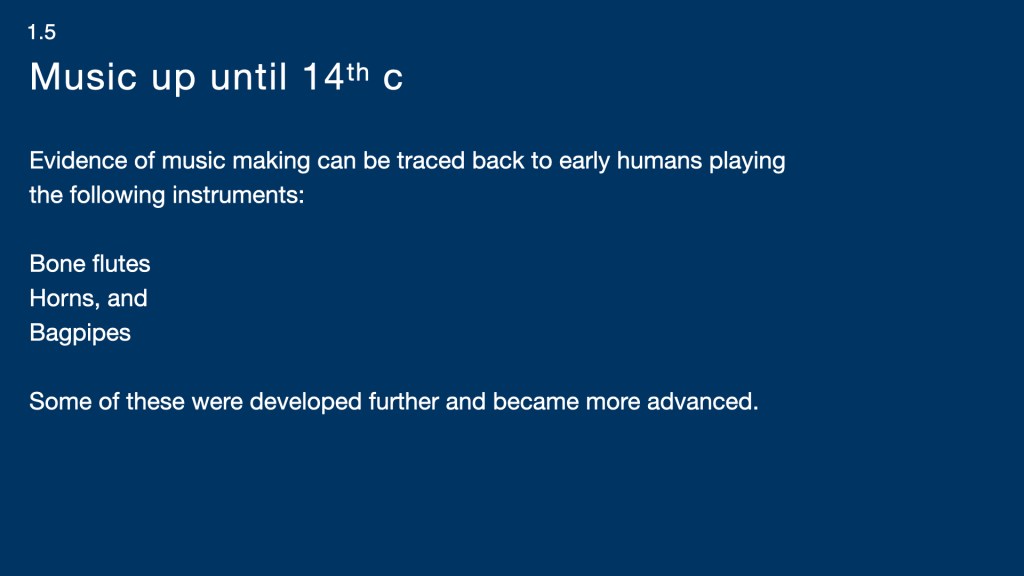
Traditional/Bobb: Scarborough Fair

Dowland: “Come Again… Sweet Love Doth Now Invite”

Wilhelm Richard Wagner
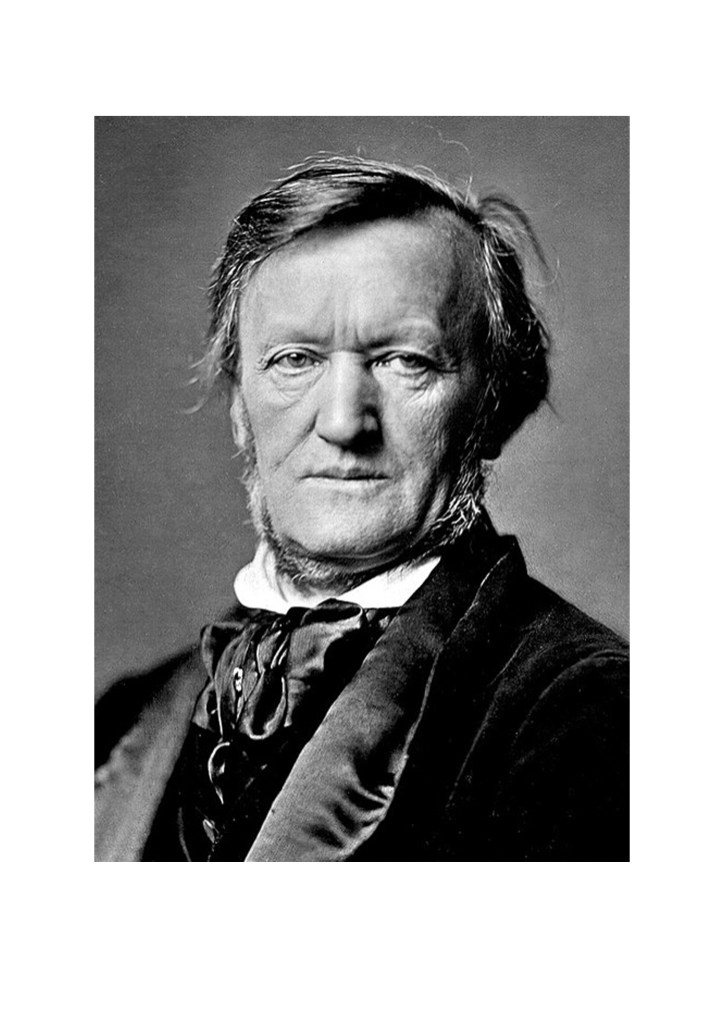
Saturday 14th June 2025, 10:30 — 12:00

Debunking Wagner
https://en.wikipedia.org/wiki/Controversies_surrounding_Richard_Wagner
?What myths have you heard about Wagner.
Ring:
‘Synopsis’
Royal Ballet & Opera video:

Rhingold ⬆️
Chapter 1: The Rhinegold
Chapter 2: The Valkyrie
Chapter 3: Siegfried
Chapter 4: Twilight of the Gods
Rhinemaidens:
Woglinde = Dance
Wellgunde = Music
Flosshilde = Poetry
Alberich – Elf, renouncing love
A representation of love: Stendhal‘s book titled Love
?What do you think about Alberich.
The following scenes in Chapter 1
Alberich’s repentance from sin. [Could Wagner be a Christian!?]
Wagner’s libretto — Stabreim
Groves Music Dictionary
Stabreim is a form of poetic verse
Iambic: Stress every second syllable
Shakespeare
Hamlet — “To be, or not to be: that is the question:”
Macbeth — “Double, double toil and trouble
Iambic Pentameter — 5 stress’ with a sentence of 10 syllables
e.g. Sonnet 18
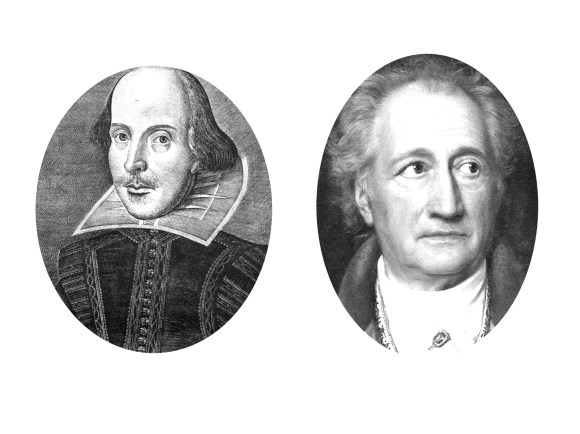
Shakespeare & Goethe known to Wagner
Henry Cuyler Bunner, American novelist and journalist, on Goethe:
Shake, Mulleary and Go-ethe, poem
My poetry books:
*Wagner’s Ring started. Not completed at the time due to Shakespearean Tudor anachronisms. However, someone said I “can still do it.” Decided on couplet paraphrase, instead — AA, BB, CC etc. Next, Simon Armitage, Poet Laureate, publishes his couplet version of the Owl and the Nightingale. Took my copy to the stage production at the Southbank Centre.
Read my incomplete paraphrase of Wagner’s Ring, Chapter 1: Rhinegold, Ii
Open mic:
Nick
Angela
Closing small talk.

"From left to right by nature’s design
Flows continuously the ready river Rhine
Lighter turquoise evenly spread
Becoming darker towards the bed
Near the floor the water dissipates
Leaving an increasingly breathable state
This vaporous man-sized space
Moves continuously and at a pace
Across the floor of the riverbed
Where no man can naturally tread
Are rough rocks and undercurrent tides
And vertical caverns unimaginably wild."
This Saturday!
As part of the Penge Festival 2025, I will be putting the case for Wagner’s Ring, debunking the myths about the composer and delivering my paraphrase of the libretto – not the entire 15 hours! we have 1.5 hours. The Rhinegold, Ii.
Open mic.

Poetry
Salutations are so important!
One Sunday morning I was preparing to meet someone. We were celebrating their birthday and my sartorial choice included a Captain’s cap, dinner shirt with cufflinks, waistcoat, black bowtie, white and gold prince tunic and English-made shoes – neck polished. On Radio 3 somebody mentioned that they will be taking over from Petroc Trelawny for the breakfast show. I said a number of disparate things. But, when I expressed:
“The last thing he will say is, ‘Good morning.’”
I should add that I too say, context permitting, after communicating in the morning:
“Good morning.”
So, when I heard this from the BBC, I cried. No, sobbed uncontrollably. Tears falling to the ground. Despite this, I remained composed and carried on with my clothes brush. I never knew the extent, depth and humanity of my emotional intelligence.
British psyche, heritage and high society? Yes, that too. And Psalm 139 in the Bible says that we are: “Fearfully and wonderfully made”.
Any breach in any of this would result in tears.
The Greeting Kiss
ANALYSIS
Verse 1:
"The greeting kiss
The holy kiss
Never to miss
This welcome kiss..."
When one meets someone else, does one kiss? Or, does one not kiss? Alternatively, does one greet with a holy kiss? Do you welcome greetings? Do you welcome people?
Verse 2:
"Means so much
Breakfast, tea, lunch
Without a thought
And never taught..."
How much does greetings mean to you at any meal? At afternoon tea, for example, would you exchange kisses? Do you think about kissing or is it natural to kiss? No, no it is natural.
Verse 3:
"Just a touch
Then its over
Sets the tone
Light as feather..."
Touching promotes health and growth. Research finds that delinquent teenagers that are touched by their parents change and are no longer delinquent. Even if it is just a touch on the shoulder now and again, the benefits are long lasting.
Verse 4:
"It means welcome
It means bless
It means connected
It means love..."
Greetings mean home, people, comfort; goodwill will follow; impossible connections becoming possible; love is all around. If God is love, then love is everywhere.
Verse 5:
"'Good you’re here'
'I know you'
'In the beloved'
Feels so true..."
Telling someone how pleased you are to see them in person and that everything will be sweetness and light is good – and part of every day life. Telling someone that I completely understand them – their intellect and emotions for example – means that you know that person. Telling someone that they will be included into a group sometime in the future, if not at the moment. And, of course, there is a need for intimacy at the fundamental level of humanity. The greeting kiss.
Verse 10:
“Suitor to Suitress
Hand gently taken
Bows down head
To touch tenderly...”
Imagine in societies where manners is everything. And you have interests in someone of the opposite sex; gentleman to gentlewoman. One would remember that she is fair and that you would, when greeting her, offer your hand. And as of upright, masculine character you would know that she needs to feel secure and allowed to be feminine. So, as I say, please “Bow down head,” gentlemen, and do not kiss her hand, but only with the very tip of your nose touch lightly.
Verse 11:
“Major key Prelude
Priming the canvas
‘Whatever happens next
You are loved’..."
In music, major and minor keys instruct what one may hear. Colloquially, happy or sad, respectfully. A Prelude is at the beginning whether in music or anything else. A greeting if you suppose. Masterworks have been, and will probably always be, created on canvas. However, before applying the oils, make sure it is alright and all white. Kisses are pure. Priming the canvas – that is, a greeting kiss – makes a masterpiece.
Verse 14:
“The greeting kiss
The holy kiss
Never to miss
This welcome kiss...”
This last verse is a repeat of the first verse emphasising the importance of kissing. So, please kiss when greeting.

“From left to right by nature’s design
Flows continuously the ready river Rhine
Lighter turquoise evenly spread
Becoming darker towards the bed
Near the floor the water dissipates
Leaving an increasingly breathable state
This vaporous man-sized space
Moves continuously and at a pace
Across the floor of the riverbed
Where no man can naturally tread
Are rough rocks and undercurrent tides
And vertical caverns unimaginably wild.“
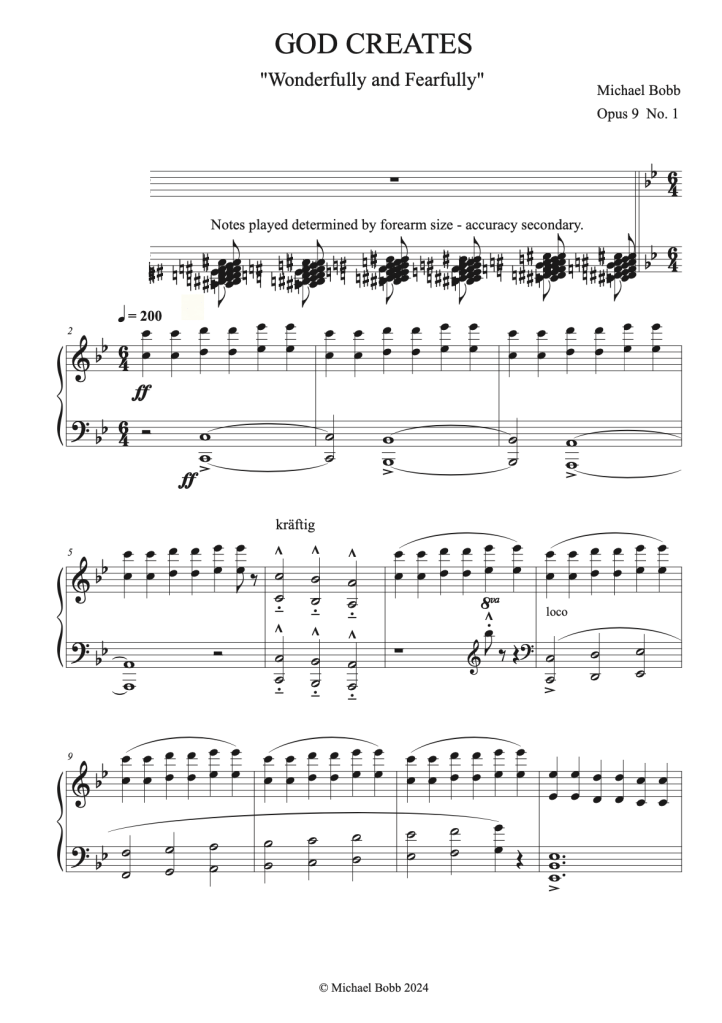
GOD CREATES was written with the sky in mind and appears in my first book. It was one of the poems that marked the start of an increase in my poetry interests following water damage to my Nikon DSLR camera. In the poem, the second person of the Trinity makes an entry, is crucified, rises from the dead, rises to the skies and returns from filling the universe to be the bridegroom at His wedding feast.
This is the only poem I have written where the title is in capital letters. Can one imagine writing anything of this nature and not use capital letters? For me the answer is: “No”. Even music I have composed on this subject has received the same treatment: a vocal chamber piece, a solo piano piece, a choral piece and an organ piece. These musical pieces, by and large, I estimate are falling within the category of virtuosity.
My GOD CREATES poem also retains, on reflection, elements of virtuosity:
I am sure these numbers mean something to somebody, somewhere!
Would there be poetry if there was not music? Or, should that be: Would there be music if there was not poetry? I hope your happy conclusion has considered at least one of my poems. Perhaps this one?
G. F. Handel (1685 – 1759), Suite Nr. 4, Sarabande. The stately pomp and majesty of this Spanish dance fitted well with the subject matter of the poem: God and God in the act of creating. The rhythmic structure of the music agrees with the rhythmic structure of the poem.
Handel wrote the music for harpsichord, originally. On this recording I am playing it on my once John Broadwood & Sons piano.

Michael Bobb Productions has announced a luxury sale of clean and pristine art, paperbacks and audiobooks of poetry, and a full-length music book for solo piano.


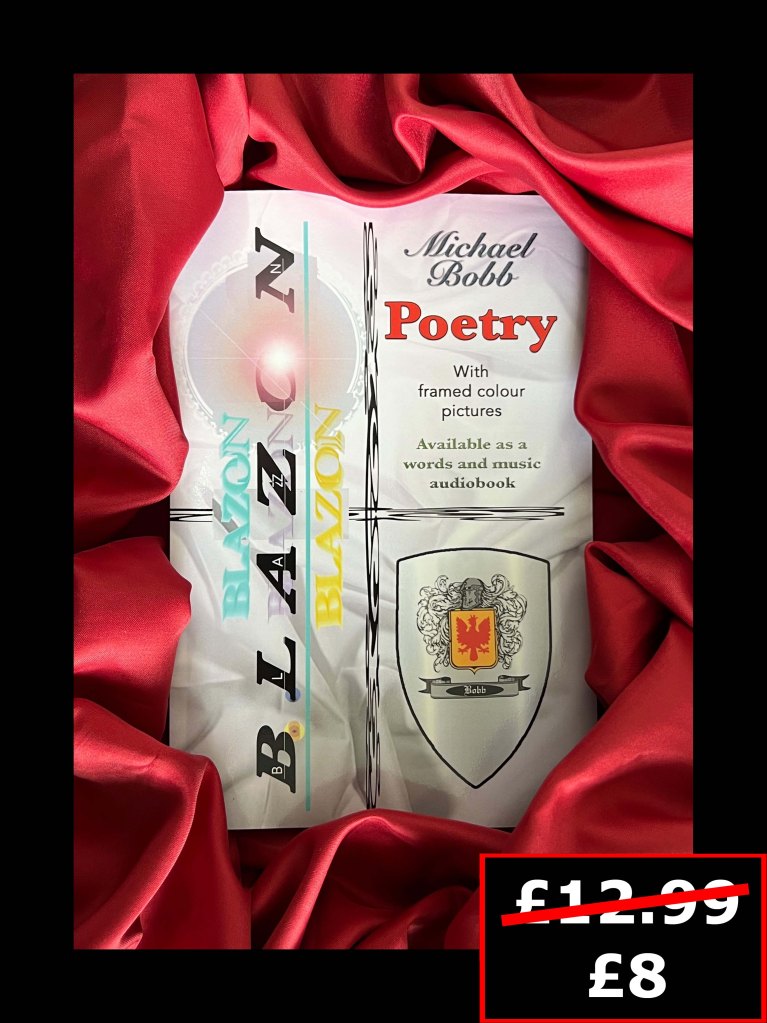


All items from Michael Bobb Productions can be found at:
Please make use of the comments section as necessary.



 Splashes of Ink